
 By Admin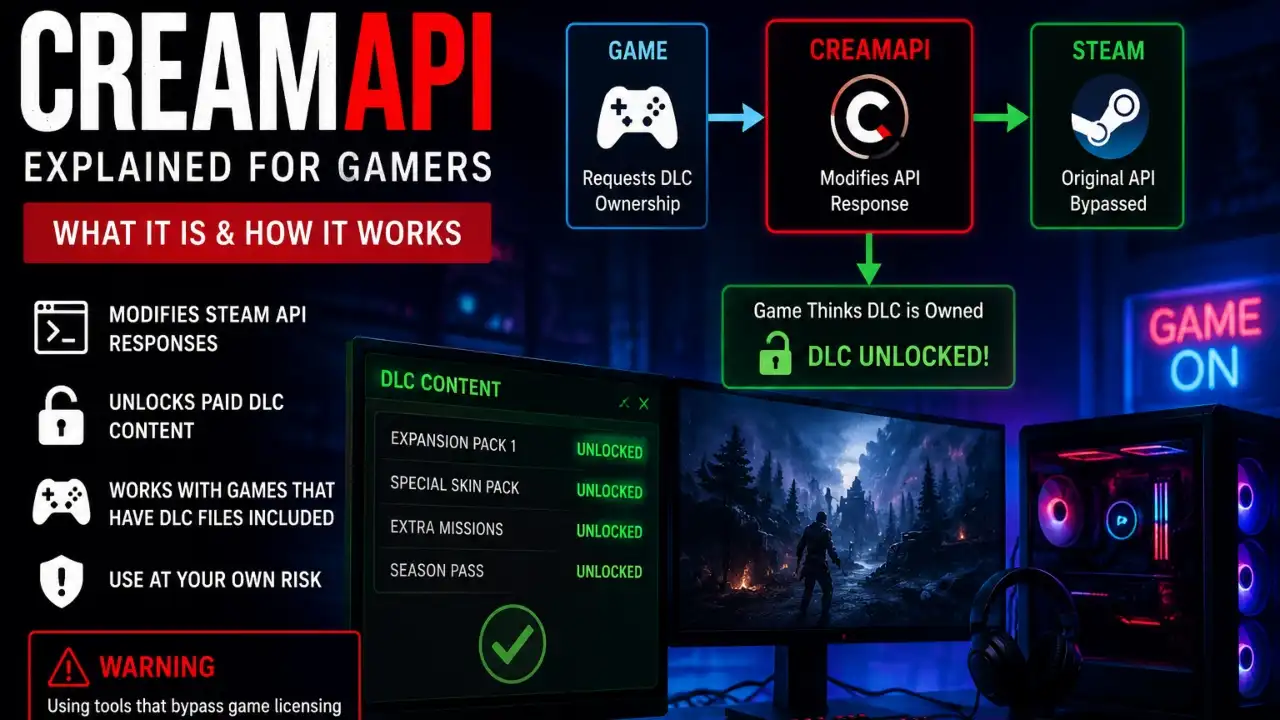
If you’ve searched for CreamAPI, you’ve likely seen mixed explanations online. Some sources describe it as a DLC unlocker, while the official project presents it as an educational, open-source configuration generator. So what’s the real story?
This guide explains what CreamAPI actually is, how it works from a technical perspective, and why it’s positioned as a research and learning tool — not a piracy solution.
What Is CreamAPI?
CreamAPI is a community-developed, open-source configuration generator designed for research, testing, and educational purposes.
According to the project’s official description, its goal is to help developers, researchers, and technology learners understand:
- How DLC configuration files are structured
- How API integrations function
- How automation systems interact with digital distribution platforms
The project does not host or distribute paid DLC files, proprietary assets, or copyrighted materials. Instead, it focuses on demonstrating how configuration systems and automation logic operate in controlled environments.
In short: CreamAPI exists to help people understand how digital content systems work behind the scenes.
Understanding CreamInstaller
The main tool associated with the project is CreamInstaller — a graphical utility built to automate DLC configuration generation for learning and testing.
CreamInstaller is:
- Independent and open-source
- Available on GitHub
- Designed for sandbox or isolated environments
- Focused on demonstrating API communication
It allows learners to observe how platforms such as Steam, Epic Games, and Ubisoft manage application data and DLC structures — without modifying or distributing paid content.
Why CreamInstaller Matters?
Many developers struggle to understand how configuration files and API responses connect. CreamInstaller simplifies that process by offering:
- Automatic game detection
- DLC configuration generation
- API data parsing demonstrations
- DLL management examples
- SteamCMD integration for build data exploration
Instead of manually analyzing raw API calls, learners can use a graphical interface to explore automation workflows step by step.
Key Features of CreamAPI and CreamInstaller
Here’s a breakdown of the educational features included in the project:
Automatic Game Detection
The tool can detect installed games across Steam, Epic, and Ubisoft platforms. This helps demonstrate how software reads local metadata safely.
Configuration Generator
It generates DLC configuration files for testing environments. These files illustrate how applications manage entitlement logic.
Multi-API Demonstration
Support for frameworks like Koaloader, SmokeAPI, and ScreamAPI helps learners see how multiple APIs interact in real-world systems.
SteamCMD Integration
SteamCMD parsing shows how build IDs, depot information, and DLC metadata are retrieved and structured.
Self-Contained Design
The software does not install real DLC content. It operates in a contained setup ideal for sandbox testing.
Automatic DLL Management
The project demonstrates how DLL files can be managed and loaded in automation environments — useful knowledge for system programmers.
How CreamAPI Works (Technical Overview)
To understand how CreamAPI works, you need to understand three core components of digital distribution systems:
- API Communication
- Configuration File Management
- Automation Logic
1. API Communication
Modern gaming platforms rely heavily on APIs to verify ownership, retrieve metadata, and manage content access.
CreamAPI demonstrates how:
- API calls are structured
- Client libraries interpret responses
- Data such as DLC lists and build IDs are parsed
For students studying backend systems, this offers a practical look at real API workflows.
2. Configuration Generation
Games often rely on configuration files that determine:
- Which DLC entries exist
- What content is associated with each app ID
- How entitlement checks are structured
CreamAPI acts as a configuration generator. It shows how such files can be created automatically based on parsed API data.
This is particularly useful for developers learning about:
- Data automation
- File structure design
- Configuration management systems
3. DLL Injection Framework Demonstration
The project also demonstrates how DLL injection frameworks operate in controlled settings.
For software engineers, this helps explain:
- How programs hook into client libraries
- How runtime behavior can be modified
- How automation layers interact with executable processes
This is not meant for production use. Instead, it provides transparency into techniques commonly discussed in systems programming courses.
Real-World Educational Applications
CreamAPI offers several practical learning benefits.
For Computer Science Students
Students studying operating systems or software engineering can:
- Analyze API request flows
- Study object-oriented design in automation tools
- Understand sandbox testing principles
For Developers
Developers can:
- Learn how large distribution platforms manage content
- Explore how build IDs and depots are structured
- Study automation techniques for repetitive configuration tasks
For Researchers
Security researchers and software analysts can:
- Observe how entitlement systems function
- Examine how configuration files are parsed
- Test automation workflows in isolated environments
Because the project is open-source, anyone can review the codebase directly and verify how it functions.
Installation Overview (For Testing Environments)
For learners exploring the project:
- Download the latest CreamInstaller release from its official GitHub page.
- Extract the files into a local test directory.
- Install .NET 7 Runtime if required.
- Launch the executable.
- Use a sandbox or isolated environment for safe experimentation.
The program is self-contained and does not modify system-level files. However, users assume full responsibility for how they use the software.
Legal and Ethical Positioning
The project explicitly states:
- It is not affiliated with Valve, Steam, Epic Games, or Ubisoft.
- It does not host copyrighted game files or DLC content.
- It is provided “as is,” without warranties.
Users are responsible for ensuring they comply with platform terms and copyright laws.
The developers strongly encourage supporting game creators by purchasing licensed content.
Why Transparency Matters in Open Source?
One of the strongest aspects of CreamAPI is transparency.
Open-source projects allow:
- Code review
- Community auditing
- Educational collaboration
- Ethical innovation
In an era where digital ecosystems grow increasingly complex, tools that explain how automation and API integration work can help developers build better, more secure systems.
However, responsible use remains essential.
Final Thoughts
CreamAPI is best understood as an educational automation and configuration research project.
It demonstrates:
- How DLC configuration systems are structured
- How APIs communicate with client applications
- How automation tools manage repetitive configuration tasks
For students and developers interested in backend systems, automation logic, and API integrations, it offers a transparent learning opportunity.
For more informative articles, visit our site daily.